

Window display design is not just a matter of creativity. Creativity matters, of course. But at some point, someone has to turn an idea into something that stands properly, fits into packaging, arrives intact at the store and can be installed without surprises.
This is where Seven Group comes in.
Brand visuals often arrive with already defined concepts, moodboards, drawings, renderings or very precise creative guidelines. Seven Group’s job is to give those designs a real physical form, translating them into custom window displays through efficient technical solutions, selected materials and tailor-made production processes.
For stores, boutiques, showrooms and retail brands, the window display is one of the first points of contact with the public. It must attract attention, enhance the product and respect the brand’s visual identity. But it must also work in practice: well produced, tested beforehand, carefully packed and installed by people who know what they are doing.
Not magic. Technical preparation, experience and control over every detail.
CONTENTS:
Why design a window display before producing it
From creative brief to design engineering
Design: aesthetics, function and feasibility
Materials and display elements for custom window displays
Window display production: when the concept becomes real
Pre-installation: test, control and packaging
On-site installation and final window display result
When to choose a custom window display
Want to turn a creative concept into a real window display?
Why design a window display before producing it
A professional window display starts from an idea, but it cannot stop at the idea. Before producing any element, the goal of the project must be clearly understood: enhancing a new collection, presenting a product, supporting a campaign, strengthening the brand’s positioning or making the point of sale more recognisable.
The design phase helps bring order to creativity, technical constraints and the final result. Every element must have a clear function: guiding the eye, highlighting the product, creating depth, respecting the proportions of the space and making the message easy to read.
Without this phase, the window display risks becoming just a decorative composition. With accurate design, instead, it becomes a commercial space conceived to communicate better and work better.
From creative brief to design engineering
The starting point is the brief. The brand or visual team presents the creative idea: style, objectives, products to be displayed, desired materials, colours, atmospheres, time of year and characteristics of the space.
From here, the technical work begins.
Seven Group analyses the concept and assesses how to make it feasible. It studies shapes, dimensions, materials, fixing systems, weights, finishes, resistance, transport and assembly. In other words, it takes a design and brings it into production reality.
This phase is central to the creation of window displays for retail brands, because it makes it possible to stay true to the creative idea without losing efficiency. The result must be beautiful, coherent and faithful to the project. But it must also be producible, replicable and installable.
For a fashion brand, for example, this may mean transforming a scenographic drawing into elegant, lightweight elements that are easy to assemble. For a boutique, it may mean creating custom display supports that enhance a small selection of products. For a retail chain, instead, it means ensuring consistency across several points of sale without lowering the quality of the final result.
Design: aesthetics, function and feasibility
Window display design for stores must catch the eye of passers-by, but it must also respect very practical rules. The elements must have the right proportions, avoid obstructing product visibility, work with the lighting, make good use of the space and support the brand image.
An effective window display is not created by filling every available centimetre. It is created by choosing what to show, what to leave breathing space around and how to guide the customer’s eye.
Seven Group works precisely on this balance: preserving the strength of the creative concept and turning it into a clean technical solution. The aim is to avoid unnecessary compromises between aesthetics and production. When the project is well engineered, the window display remains faithful to the original idea and works in practice too.
Materials and display elements for custom window displays
The choice of materials has a major impact on the final result of a display setup. Every material brings with it a visual effect, a tactile perception, a weight, a cost, a lifespan and a specific production method.
For this reason, in custom window displays, material selection cannot be random. It must respond to the concept, the budget, the production timing and the installation requirements.
Seven Group works with materials and finishes selected according to the project: display supports, backdrops, shaped panels, suspended elements, freestanding structures, bases, scenographic wings, decorative objects, prints, graphics, window decals and custom-made components.
Customisation makes it possible to go beyond the limits of standard solutions. A tailor-made element adapts better to the space, enhances the product more effectively and makes the window display more recognisable than a generic setup.
Window display production: when the concept becomes real
The production of window displays is the phase in which the project takes shape. This is where experience, precision and the ability to solve problems before they become real problems are needed.
Seven Group translates the design into physical elements, taking care of dimensions, production processes, finishes, assembly systems, stability and visual result. Every component must respect the concept, while also making transport, packaging and installation easier.
This aspect becomes even more important when working with retail brands, boutiques or store chains. Quality must remain consistent. Materials must maintain the same effect across multiple supplies. Elements must arrive ready to be installed without improvisation.
A good display setup is not judged only when it is photographed in the window. It is also judged when it is produced, handled, shipped and assembled.
Pre-installation: test, control and packaging
Before delivery, Seven Group can carry out a pre-installation test phase. This is a very important step, because it makes it possible to verify the real result of the elements before they reach the point of sale.
The test helps check proportions, joints, stability, finishes, message readability and consistency with the approved concept. If something needs to be corrected, it is better to discover it in the workshop than in front of the client’s window display.
Packaging also plays a decisive role. The elements of a window display can be delicate, shaped, painted, printed or made up of several parts. For this reason, they must be carefully protected, organised in a logical way and prepared to make the work of the on-site installers easier.
It may seem like a detail. It is not.
On-site installation and final window display result
A window display is not finished when it leaves production. It is finished when it is installed correctly and delivers the effect expected from the project.
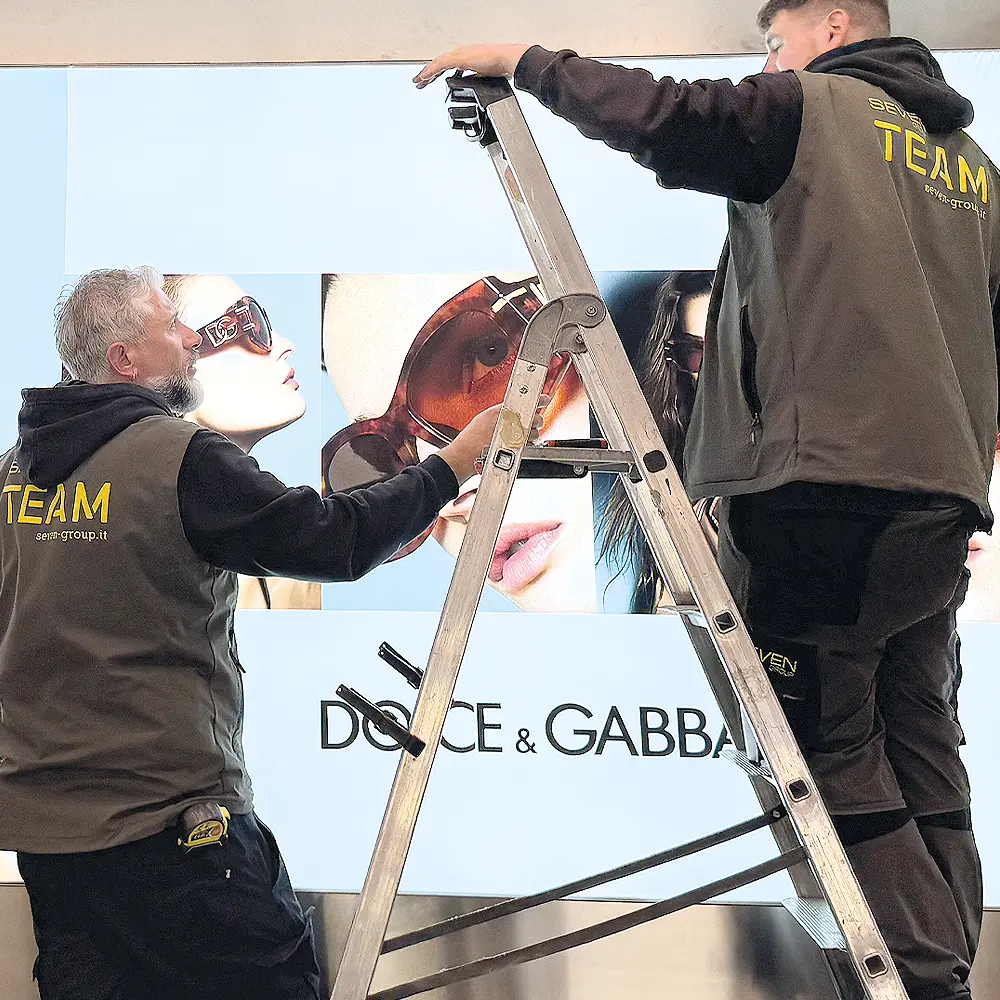
This is why Seven Group also takes care of the on-site installation phase, relying on experienced installers. Assembly requires precision, knowledge of materials and attention to detail: alignments, distances, proportions, stability, lighting and the relationship with the products on display.
The window display must look natural, clean and coherent. Behind it, however, there is very concrete technical work. And it is precisely this work that allows the initial design to retain its strength in the real space.
When to choose a custom window display
A custom window display is the right choice when a brand wants to communicate a precise identity, enhance a campaign or stand out in a competitive context.
Standard solutions may be suitable for simple decorations or quick interventions. But when the visual setup must respect brand guidelines, materials, colours, proportions and messages, a tailor-made project is needed.
This applies to boutiques, premium stores, showrooms, fashion brands, retail chains and commercial spaces that want to use the window display as a communication space, not just as an exhibition surface.
In these cases, the difference is not made only by the creative idea. It is made by the ability to produce it well.
Want to turn a creative concept into a real window display?
Seven Group supports brands, visual merchandisers and retail managers in the creation of custom window displays, taking care of design engineering, material selection, production, pre-installation testing, packaging and on-site installation.
View some completed projects and discover how Seven Group transforms brand visuals into concrete, carefully crafted window displays ready for the point of sale.
Related articles
Counter Displays: Materials, Formats and Solutions for the Point of Sale
Guide to counter displays for products and points of sale: materials, formats,…
How to Become a Visual Merchandiser
In this guide, you will find a clear and practical path to understanding the…
Prototyping in packaging and displays: why test before producing.
Discover the importance of prototyping in packaging and displays. Mock-ups,…