

Counter displays are compact supports designed to give visibility to products, samples, brochures, postcards, promotional materials and small items. They are used on counters, desks, checkout areas, tables, shelves, exhibition stands and sales areas where space is limited but customer attention is highly valuable.
A good counter display does not simply “keep the product tidy”. It must make it more visible, more accessible and more consistent with the brand image. This is why the choice of material, format and structure directly affects the final result at the point of sale.
Cardboard, plexiglass, wood, metal, shelves, hooks, leaflet pockets or hybrid solutions: every choice must be assessed according to the product to be displayed, the commercial context and the communication objective.
CONTENTS:
When to choose a counter display
Cardboard counter displays: lightweight, versatile and customizable
Plexiglass, wood and metal counter displays
Formats and functions: shelves, hooks, pockets and A4 format
Tabletop displays and counter displays: are they the same thing?
Counter displays or floor displays?
What determines the price of a counter display
Standard or custom counter displays: which should you choose?
Seven Group: from idea to sales counter, custom-designed displays
When to choose a counter display
A counter display is useful when the product needs to be seen up close and easily reached by the customer. It is a suitable solution for small items, promotional products, samples, accessories, cosmetics, sweets, gadgets, postcards, flyers, catalogues, brochures and information materials.
It works well in stores, showrooms, pharmacies, perfumeries, stationery shops, boutiques, specialised retail outlets, trade fairs and events. In all these contexts, the counter is a valuable space: if used well, it can become a direct point of contact between product and customer.
A custom counter display also supports promotional activities. It can accompany the launch of a product, support a temporary campaign, highlight a specific line or make a selection of items more organised.
Cardboard counter displays: lightweight, versatile and customizable
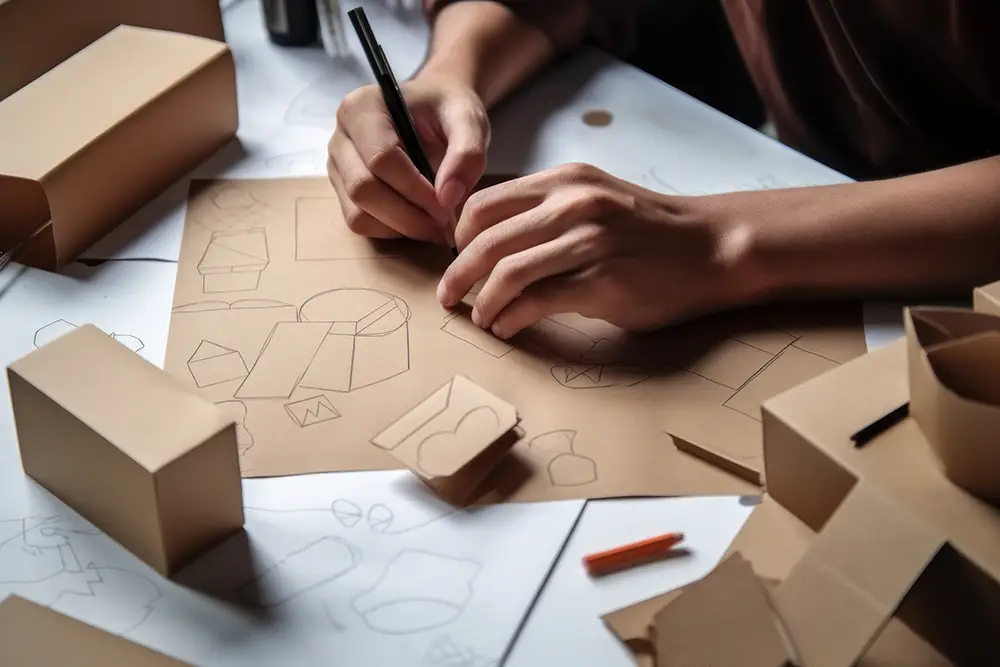
Cardboard counter displays are among the most requested solutions because they combine lightness, graphic customisation and practicality. They can be printed, shaped, die-cut and designed according to the product they need to hold.
Cardboard is especially suitable for promotional campaigns, temporary displays, cardboard leaflet holders, postcard displays, small cardboard stands, trade fair materials and counter displays intended for lightweight products.
A cardboard display can also be a custom solution. It should not be seen as an alternative to customisation, but as one of the possible materials for creating personalised displays. Shape, dimensions, graphics, joints, shelves and pockets can be designed according to the needs of the brand and the point of sale.
Plexiglass, wood and metal counter displays
Not every project requires cardboard. In some cases, more resistant, more elegant materials are needed, or materials that are more consistent with the product positioning.
Plexiglass is suitable when a clean, light and modern effect is required. It is useful for transparent displays, supports for small products, tabletop displays, postcard holders, leaflet holders and solutions where the product must remain the main focus.
Wood communicates solidity, warmth and attention to detail. It can be suitable for premium, artisanal or natural products, or for brands that want to convey a more material perception.
Metal is chosen when stability, durability and a more resistant structure are required. It is useful for counter displays with hooks, supports for blister-packed products, accessories, small objects or items that require greater strength.
Often the best solution comes from combining several materials. Cardboard, plexiglass, wood, metal and printing can work together to create a functional, recognisable display that is consistent with the brand.
Formats and functions: shelves, hooks, pockets and A4 format
The shape of a display depends on what it needs to hold. A small product does not have the same requirements as a brochure. A hanging item requires a different structure from a sample placed on a surface. It may seem obvious, but this is where many standard displays start to show their limits.
Among the most widely used solutions are displays with shelves, suitable for multiple products or coordinated lines; counter displays with hooks, useful for blisters, accessories and small packaged items; leaflet pockets, designed for brochures, flyers and catalogues; A4 counter displays, suitable for more visible information materials; displays for postcards, flyers and promotional communications.
Very different sectors can also have similar needs. A stationery display, a counter display for sweets or a cosmetics display must all answer the same question: how can the product be presented in a clear, stable and immediate way?
The answer changes according to weight, dimensions, frequency of use, product quantity, campaign duration and available space. On this topic, it may also be useful to explore the dimensions of a counter display and how to assess them according to the product to be displayed.
Tabletop displays and counter displays: are they the same thing?
The terms tabletop display and counter display are often used as synonyms. In both cases, they refer to compact supports placed on a surface: sales counter, desk, promotional table, information desk or shelf.
The difference depends more on the context than on the technical features. “Counter display” is used mainly in retail and at the point of sale. “Tabletop display” is common at trade fairs, events, showrooms and product presentations.
In both cases, the goal remains the same: to give visibility to the product or promotional material in a limited space, without creating disorder and without making customer interaction more difficult.
Counter displays or floor displays?
When the product is small or the promotional material needs to stay close to the customer, the counter is the most natural choice. When, instead, a larger, independent structure is needed, visible even from a distance, a floor display may be more suitable.
Custom floor displays are suitable for bulkier products, wider assortments, important promotional communications or sales areas where the counter is not enough.
The two solutions are not in competition. They can also work together: a floor display can attract attention in the sales area, while a counter display can encourage direct contact with the product or information material.
What determines the price of a counter display
The price of a counter display depends on several factors: chosen material, dimensions, structural complexity, quantity produced, type of printing, finishes, production processes, assembly systems and level of customisation.
A cardboard display for a temporary campaign will have different costs from a plexiglass, wood or metal display designed to last longer. In the same way, a production run involving several pieces requires different evaluations from a single prototype or a small series.
This is why it is difficult to talk about display prices without knowing the product to be displayed and the context of use. Correct design, however, makes it possible to find the right balance between aesthetic result, functionality, materials and budget.
Standard or custom counter displays: which should you choose?
Standard displays can be useful when a quick and generic solution is needed. But if the product has specific characteristics, if the brand needs to be recognisable or if the point of sale requires a more refined presentation, customisation becomes decisive.
A custom counter display makes it possible to adapt shape, structure, materials, graphics and finishes to the real product. It does not start from a one-size-fits-all model, but from what needs to be displayed: weight, dimensions, number of pieces, handling method, visibility, duration and commercial context.
This makes the display more effective at the point of sale and more consistent with the brand’s communication.
Seven Group: from idea to sales counter, custom-designed displays
Seven Group designs and produces custom counter displays for products, promotional materials, stores, trade fairs and retail spaces. Every project is developed by evaluating the product, brand, materials, structure, finishes and methods of use.
The goal is to create functional, solid display supports that are consistent with the client’s image, capable of enhancing the product and improving its presence at the point of sale.
Want to see concrete examples? View some custom counter displays designed and produced by Seven Group.
Related articles

Window Display Design: From Concept to Custom Production
How a custom window display is created: concept, design, materials, production…

How to Become a Visual Merchandiser
In this guide, you will find a clear and practical path to understanding the…
Prototyping in packaging and displays: why test before producing.
Discover the importance of prototyping in packaging and displays. Mock-ups,…